HABITAT LEARNING LAB:

Field Investigation: Birds and Their Adaptations

Click on the maroon links to access free educational materials:

Lesson Plans | ALSDE Standards Taught

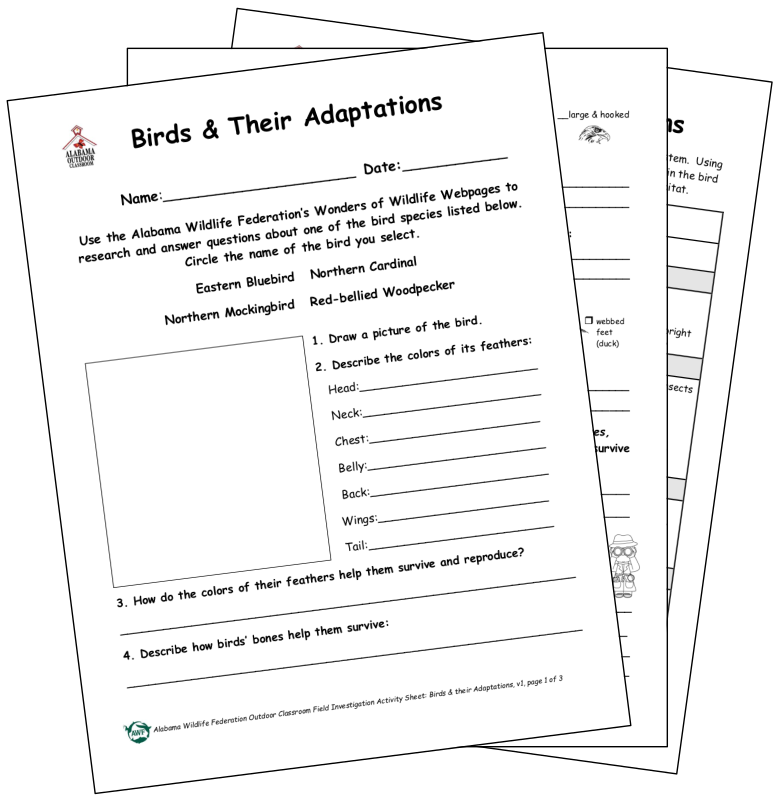
Activity Page #1: Birds & Their Adaptations (or as Word Doc)

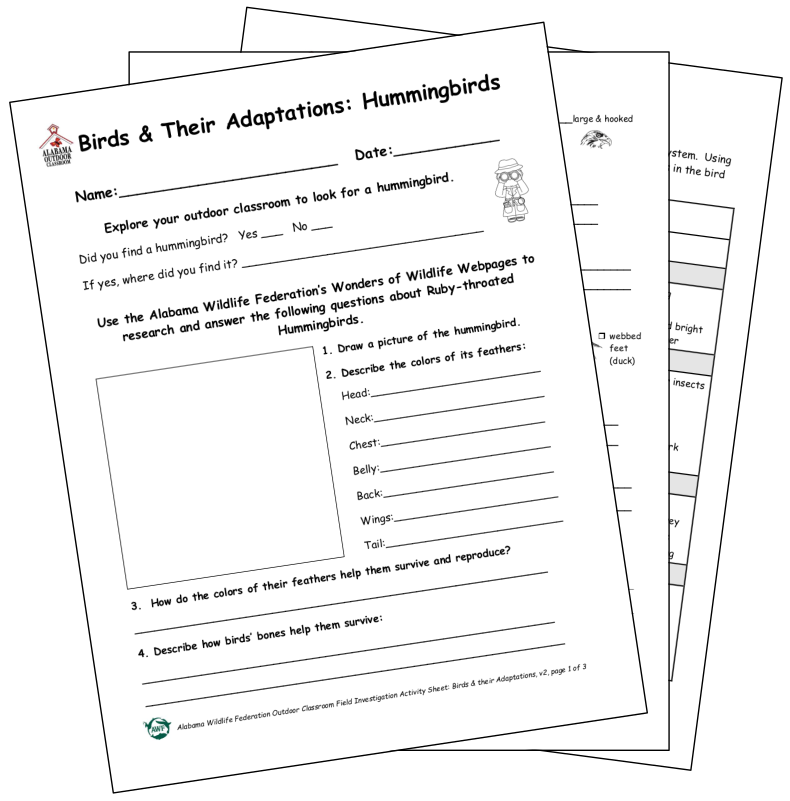
Activity Page #2: Hummingbirds & Their Adaptations (or as Word Doc)
with Answer Page #2

Outdoor Activity Materials: activity pages, clipboards, pencils, copies of field identification guides

Step 1: Engage through Discussion

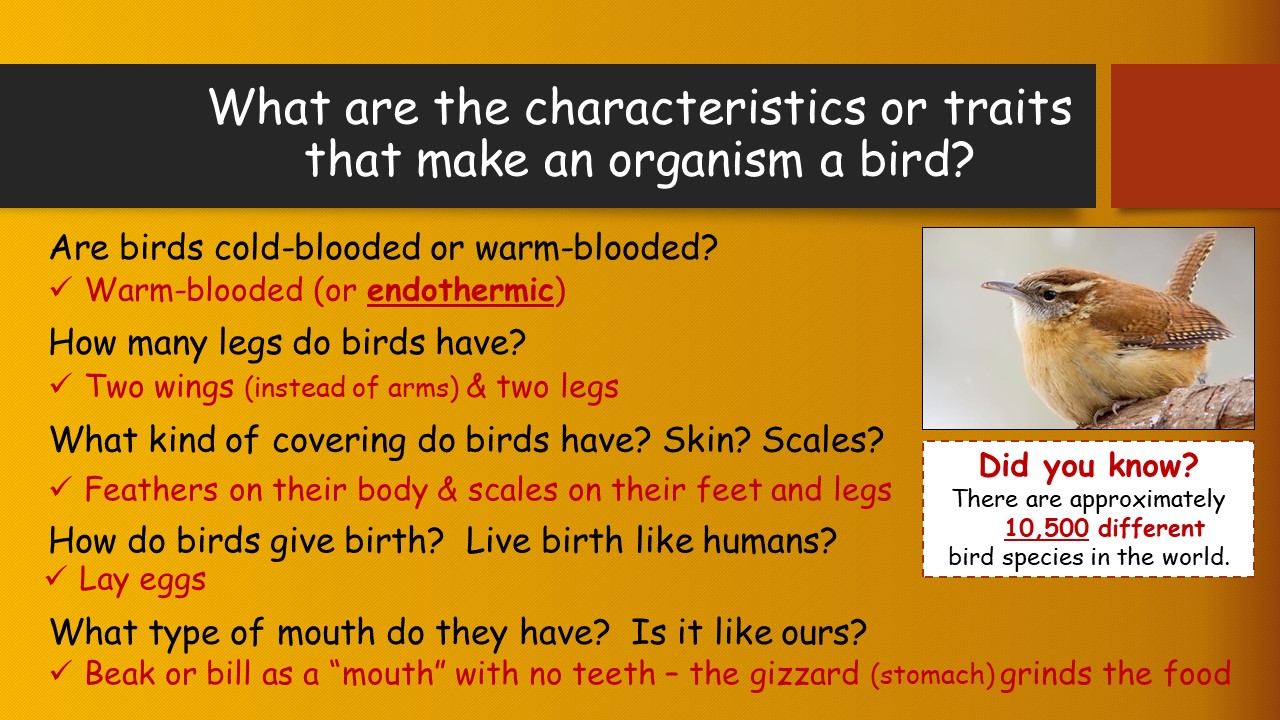
Engage the students and capture their interests with an Interactive PowerPoint and Q&A (or as PDF) that allows you to click through the questions and answers separately, so that you have time to discuss possible answers with your students BEFORE showing them the answer on the slide. You can gauge your students’ understanding of the topic as they answer the questions.

Use these tools to continue the discussion:


Tip #1: 
Print and use the 
Q&A Info Sheet (or as Word Docto anticipate the next question in the Interactive Q&A and to guide the conversation with the students.

Tip #2:
 
To use the PowerPoint (PPT) for an interactive discussion, you must click “Slide Show” & “From Beginning” to display the questions and answers separately.

Step 2: Explore with Literature

As you read these books, you can further explore the topic and discuss your students’ experiences and knowledge around the topic:

Feathers: Not Just For Flying by Melissa Stewart

ISBN: 978-1-58089-431-9

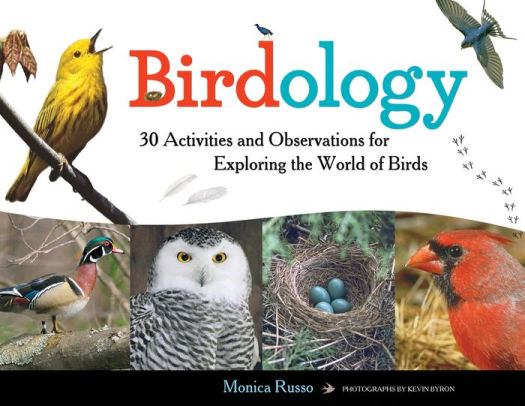
Birdology by Monica Russos ISBN: 978-1-61374-949-4

A Backyard Birding Adventure: What’s in Your Yard by Kermit Cummings ISBN: 978-1612542362

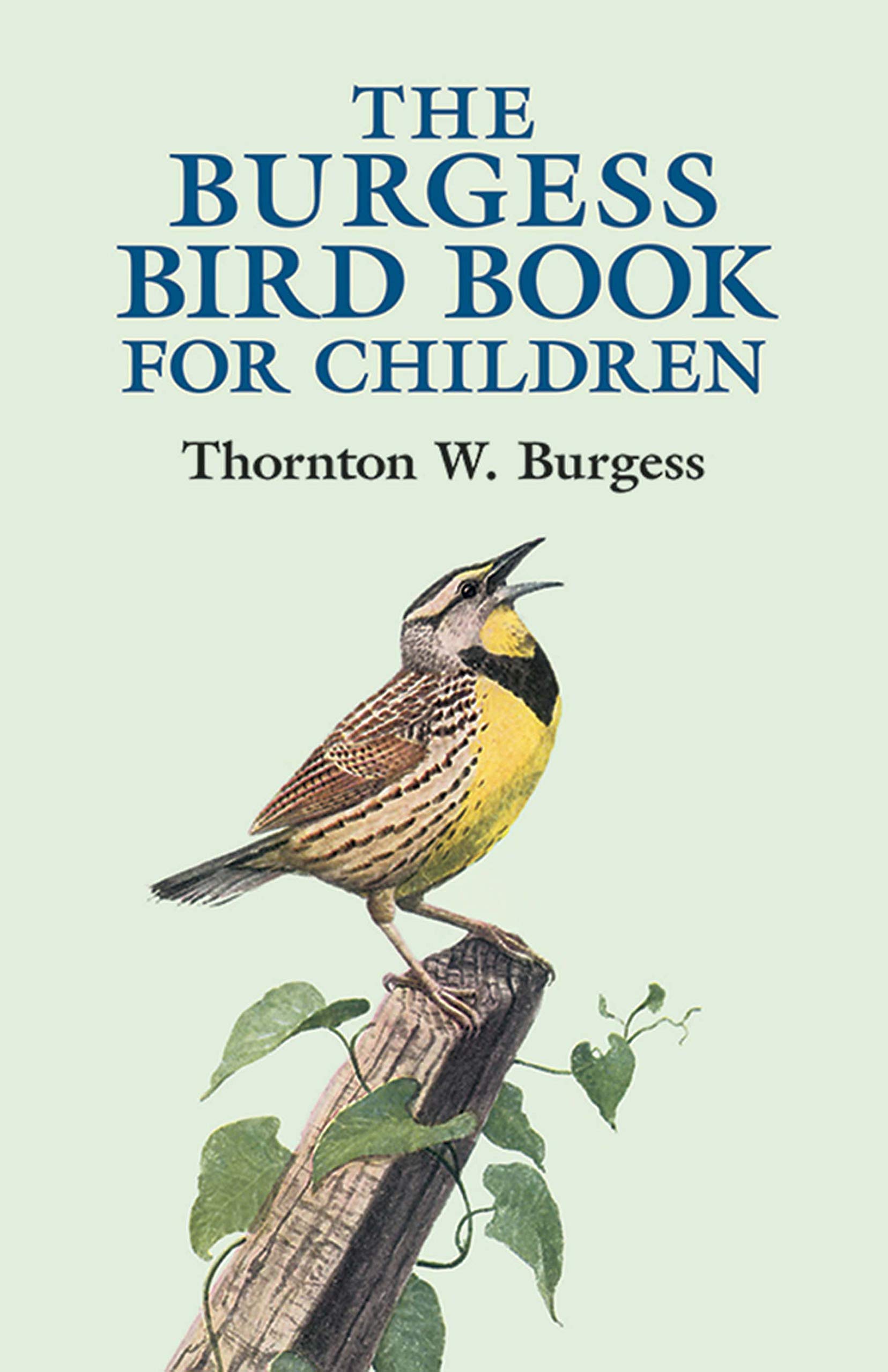
The Burgess Bird Book for Children (Dover Children’s Classics) by Thorton W. Burgess ISBN: 978-0486428406

Step 3: Explain with Educational Videos

Birds: Educational Video for Kids 
by Happy Learning (4:26 min.)

Bird Evolution and Adaptations 
by Discovery Channel (3:15 min.)

Step 4: Elaborate with a Field Investigation in the Habitat Lab

Students apply what they have learned as they investigate the topic in your Habitat Lab and record their real-world observations on their activity page:

Activity Tips

Version #1 – Birds and Their Adaptations
Activity Page: PDF (as is) / Word Doc (editable)

Procedure

Indoor Discussion:

  1. Have the students use the AWF’s Wonders of Wildlife webpages to research the Eastern BluebirdNorthern CardinalNorthern Mockingbird, or Red-bellied Woodpecker
  2. Next, they draw a picture of the bird and describe its characteristics on the activity page.
  3. Then they describe the bird’s physical features and answer questions about how these adaptations help the bird survive.


Outdoor Discovery:

  1. Next, they explore the Habitat Lab to look for their selected bird species and where they found it.
  2. They also observe other bird species and provide a description for any additional bird species that they see.


Indoor Discussion:

  1. Discuss the names and physical features of the birds that were observed in the Habitat Lab.
  2. Discuss how those physical features help the birds survive.
  3. Discuss the internal and external structures of animals that function to support survival, growth, and reproduction.


Optional Extension:

Version #2 – Hummingbirds and their Adaptations
Activity Page: PDF (as is) / Word Doc (editable)

Procedure
Outdoor Discovery:
  1. Have the students explore the Habitat Lab to search for the Ruby-throated Hummingbird.
  2. On their activity page, they should indicate if they saw any hummingbirds and where they were located.

Indoor Discussion:

  1. Students use the AWF’s Wonders of Wildlife webpage to research the Ruby-throated Hummingbird.
  2. Next, they draw a picture of the Ruby-throated Hummingbird and describe its characteristics on the activity page.
  3. Then they describe the bird’s physical features and answer questions about how these adaptations help the bird survive.
  4. Discuss the internal and external structures of animals that function to support survival, growth, and reproduction.


Wildlife Identification Resources:

Step 5: Evaluate with an Assessment Activity

Review and assess the students’ observations and answers on their observation pages:

Evaluate the students’ understanding of the topic with the following assessment tool:


Questions?
 Contact us.