


Students look for a bird, insect, amphibian, reptile or mammal in the Habitat Lab, record its features, and then describe its habitat. Afterwards, they discuss how and why different animals were found in different places in the Habitat Lab.
Click on the links below to access free educational materials:
Lesson Plans | ALSDE Standards Taught
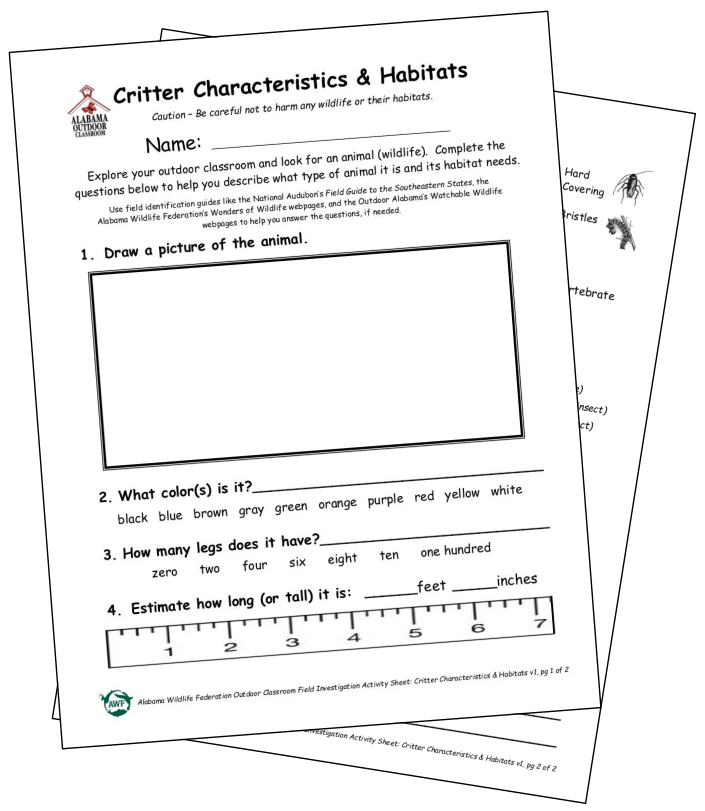
Activity Page #1: Critter Characteristics & Habitats (or as Word Doc)
Activity Page #2: Eastern Bluebird & its Habitat Needs (or as Word Doc) with Answer Page
Outdoor Activity Materials: activity pages, clipboards, pencils, field identification guides such as the National Audubon Society Field Guide to the Southeastern States
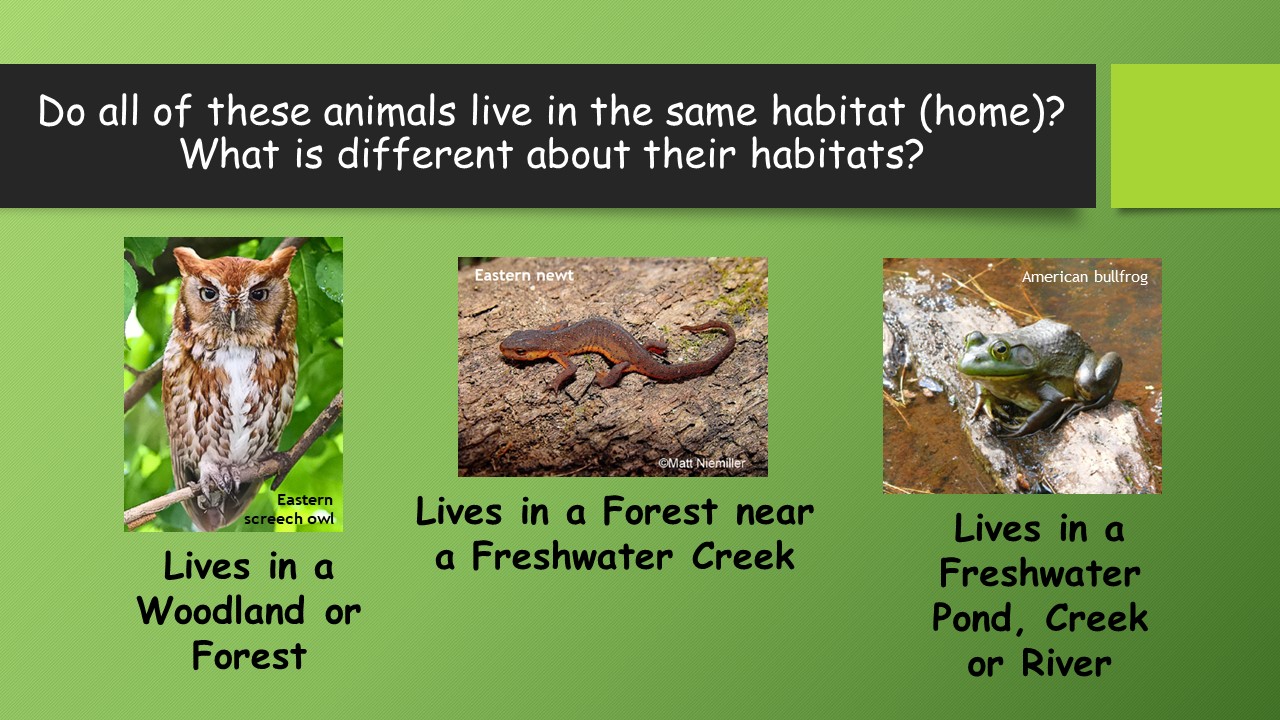
Engage the students and capture their interests with an Interactive Q&A (or as PDF) that allows you to click through the questions one at a time. You can gauge your students’ understanding of the topic as they answer the questions. Print and use the Q&A Info Sheet (or as Word Doc) to anticipate the next question in the Interactive Q&A and to guide the conversation with the students. (Note: For the PowerPoint (PPT), click “Slide Show” & “From Beginning” to display the questions and answers separately.)
Use these tools to continue the discussion:
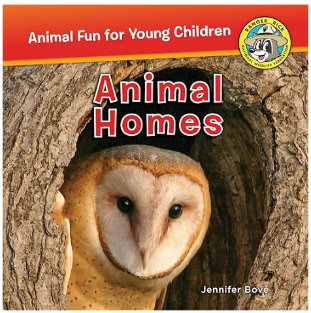
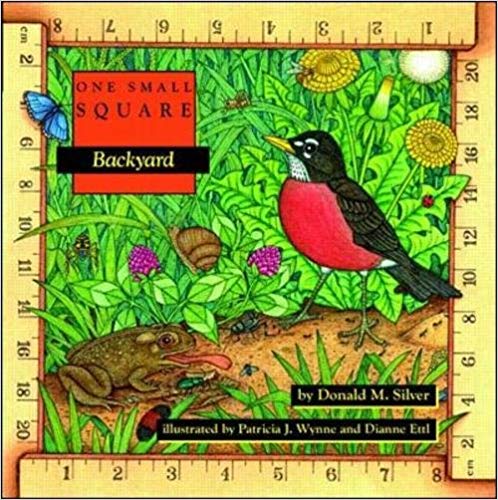
As you read these books, you can further explore the topic and discuss your students’ experiences and knowledge around the topic:
Animal Homes (Ranger Rick: Animal Fun for Young Children) by Jennifer Bove’ (ISBN: 978-1630762247)
One Small Square: Backyard by Donald M. Silver (ISBN: 978-0070579309)
One Small Square: Woods by Donald M. Silver (ISBN: 978-0070579330)
One Small Square: Swamp by Donald M. Silver (ISBN: 978-0070579262)
One Small Square: Pond by Donald M. Silver (ISBN: 978-0070579323)
Animal Habitats (My Science Library, Levels 1-2) by Julie K. Lundgren (ISBN: 978-1617419348)
Animal Classification YouTube Video (6:51 min) @ https://www.youtube.
com/watch?v=mRidGna-V4E
Animal Classification Brain Pop Jr. Video (5:48 min)
@ https://jr.brainpop.com
/science/animals/classifying
animals/
Nature: Animal Homes PBS
Learning Media Video (2:07 min) @ https://www.pbslearningmedia
.org/resource/
nat15.sci.lisci.anihome/habitat-animal-homes/#.W3R81ehKg2w
What is a Habitat? Video (2:56 min)
@ https://www.youtube.com
/watch?v=CxrlEajA398
Wildlife Identification Resources:
Wildlife Identification Resources:
Students apply what they have learned as they investigate the topic in your Habitat Lab and record their real-world observations on their activity page:
Activity Tips
Version #1 – An Animal & Its Habitat Needs: General Animal
Activity Page: PDF (as is) / Word Doc (editable)
Procedure
Outdoor Discovery:
Indoor Discussion:
Optional Extension:
Version #2 – An Animal & Its Habitat Needs: Eastern Bluebird
Activity Page: PDF (as is) / Word Doc (editable)
Procedure
Outdoor Discovery:
Indoor Discussion:
Optional Extension:
Wildlife Identification Resources:
Wildlife Identification Resources:
Review and assess the students’ observations and answers on their observation pages:
Evaluate the students’ understanding of the topic with the following assessment tools:
Questions? Contact us.
