Students find evidence of a food web that exists within the school’s Habitat Lab and create a model to show the transfer of matter and energy within the environment between producers, consumers, and decomposers.
Click on the maroon links to access free educational materials:
Lesson Plans | ALSDE Standards Taught
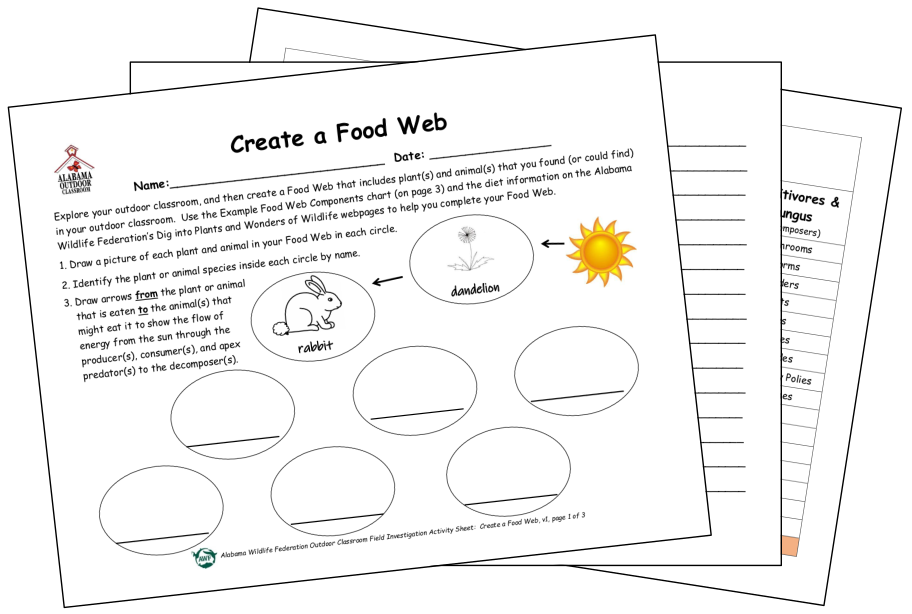
Activity Page #1: Create a Food Web – General Plants and Animals (or as Word Doc)
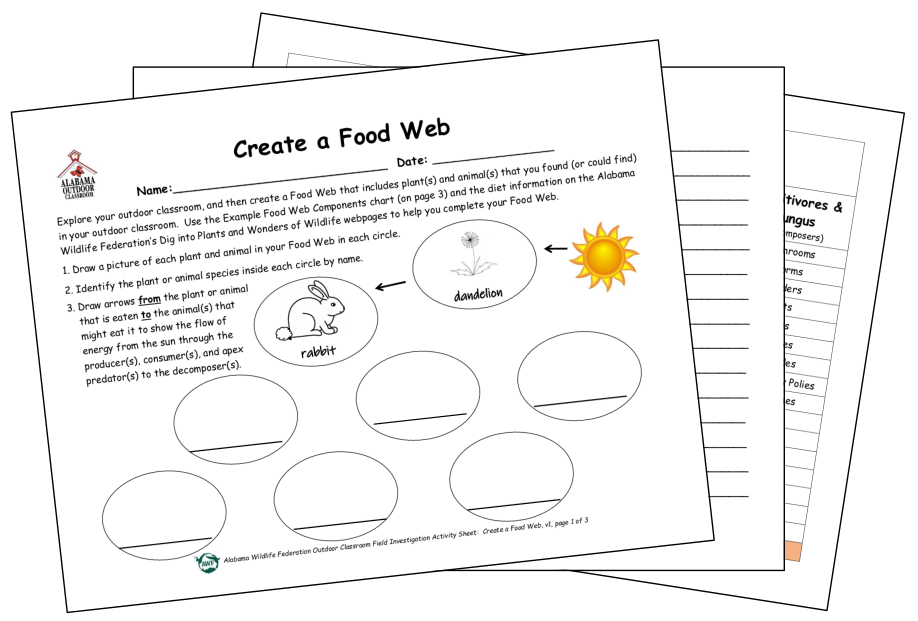
Activity Page #2: Create a Food Web with Decomposers (or as Word Doc)
with Answer Page #2
Outdoor Activity Materials: activity pages, clipboards, pencils
Engage the students and capture their interests with an Interactive Q&A (or as PDF) that allows you to click through the questions one at a time. You can gauge your students’ understanding of the topic as they answer the questions. Print and use the Q&A Info Sheet (or as Word Doc) to anticipate the next question in the Interactive Q&A and to guide the conversation with the students. (Note: For the PowerPoint (PPT), click “Slide Show” & “From Beginning” to display the questions and answers separately.)
Use these tools to continue the discussion:
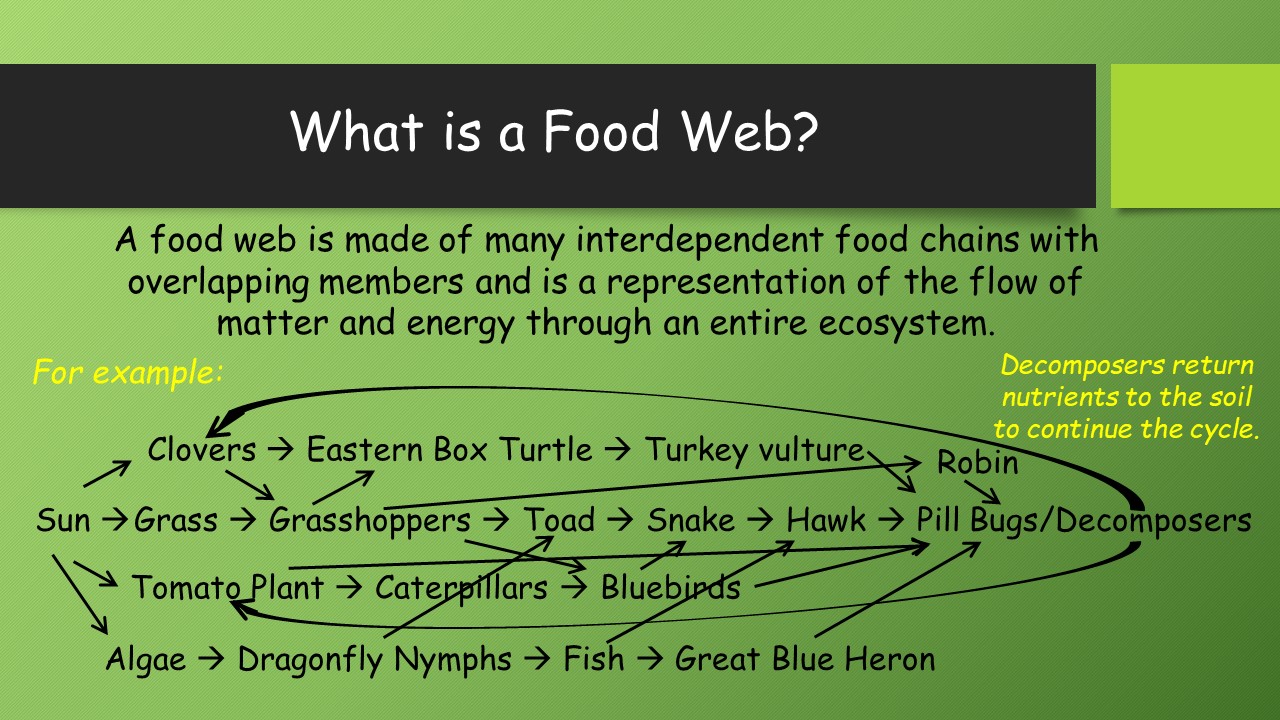
As you read these books, you can further explore the topic and discuss your students’ experiences and knowledge around the topic:
What are Food Chains & Food Webs (The Science of Living Things) by Bobbie Kalman ISBN: 978-0865058880
Secrets of the Garden: Food Chains and the Food Web in Our Backyard by Kathleen Weidner Zoehfeld ISBN: 978-0385753647


Home Sweet Habitat
by Crash course Kids #21.1 (4:41 min)
@ https://www.youtube.com/watch?v=p15IrEuhYmo
Home Sweet Habitat
by Crash course Kids #21.1 (4:41 min)
@ https://www.youtube.com
/watch?v=p15IrEuhYmo
The Importance of Food Webs
by Crash Course Kids #21.2 (3:51 min.)
@ https://www.youtube.com/watch?v=Vtb3I8Vzlfg
The Importance of Food Webs
by Crash Course Kids #21.2 (3:51 min.)
@ https://www.youtube.com
/watch?v=Vtb3I8Vzlfg
The Food Chain
by Odyssey Earth (4:49 min.)
@ https://www.youtube.com/watch?v=0ZOvqYypOuo
The Food Chain
by Odyssey Earth (4:49 min.)
@ https://www.youtube.com
/watch?v=0ZOvqYypOuo
The Food Web
by Odyssey Earth (3:07 min.)
@ https://www.youtube.com/watch?v=MGODmyXkkPU
The Food Web
by Odyssey Earth (3:07 min.)
@ https://www.youtube.com
/watch?v=MGODmyXkkPU
Students apply what they have learned as they investigate the topic in your Habitat Lab and record their real-world observations on their activity page:
Activity Tips
Version #1 – Create a Food Web: General Plant or Animal
Activity Page: PDF (as is) / Word Doc (editable)
Procedure
Outdoor Discovery:
Indoor Discussion:
Version #2 – Create a Food Web: Decomposer
Activity Page: PDF (as is) / Word Doc (editable)
Procedure
Outdoor Discovery:
Indoor Discussion:
Optional Extension:
Wildlife Identification Resources:
Version #2 – Create a Food Web: Decomposer
Activity Page: PDF (as is) / Word Doc (editable)
Procedure
Outdoor Discovery:
Indoor Discussion:
Optional Extension:
Wildlife Identification Resources:
Review and assess the students’ observations and answers on their observation pages:
Evaluate the students’ understanding of the topic with the following assessment tool:
Questions? Contact us.