


Below are maintenance tips and resources that you and your Habitat Lab planning committee can use to help sustain your outdoor learning stations and your Habitat Lab from year to year. If you have trouble accessing any of the linked files on this page, reach out to your AWF HLL Specialist.
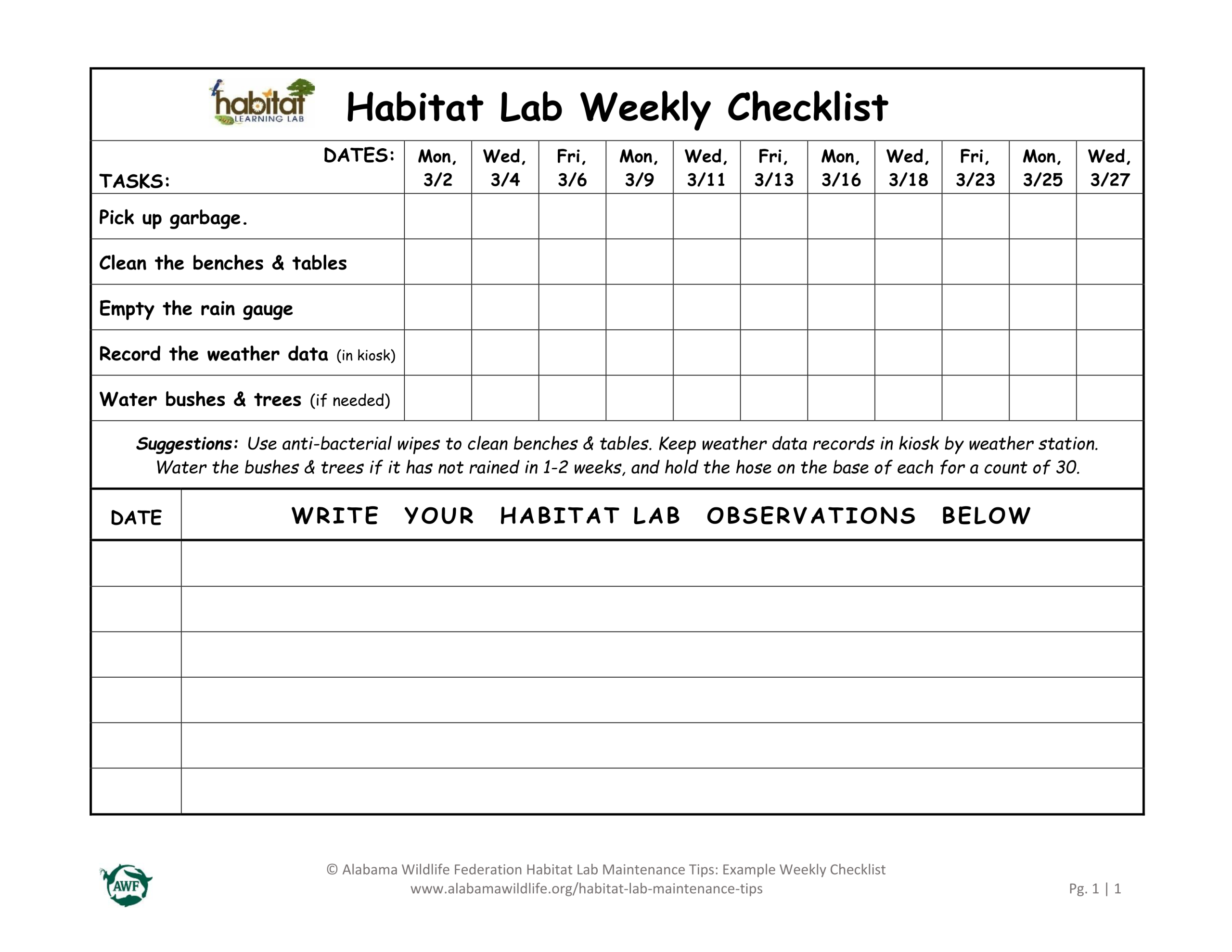
Tip #1: Create a list of tasks that you need done multiple times per week such as picking up garbage, emptying the rain gauge, and recording the weather data. Example Weekly Maintenance Checklist: (Word Doc | PDF)
Tip #2: Ask students from your Habitat Lab/Wildlife/Gardening Club or another student club to assist with the Weekly Maintenance Checklist each week. Allow the students to rotate who is in charge of the checklist each week or each month.
Tip #3: Create a schedule so that the students check the Habitat Lab at least three times per week.
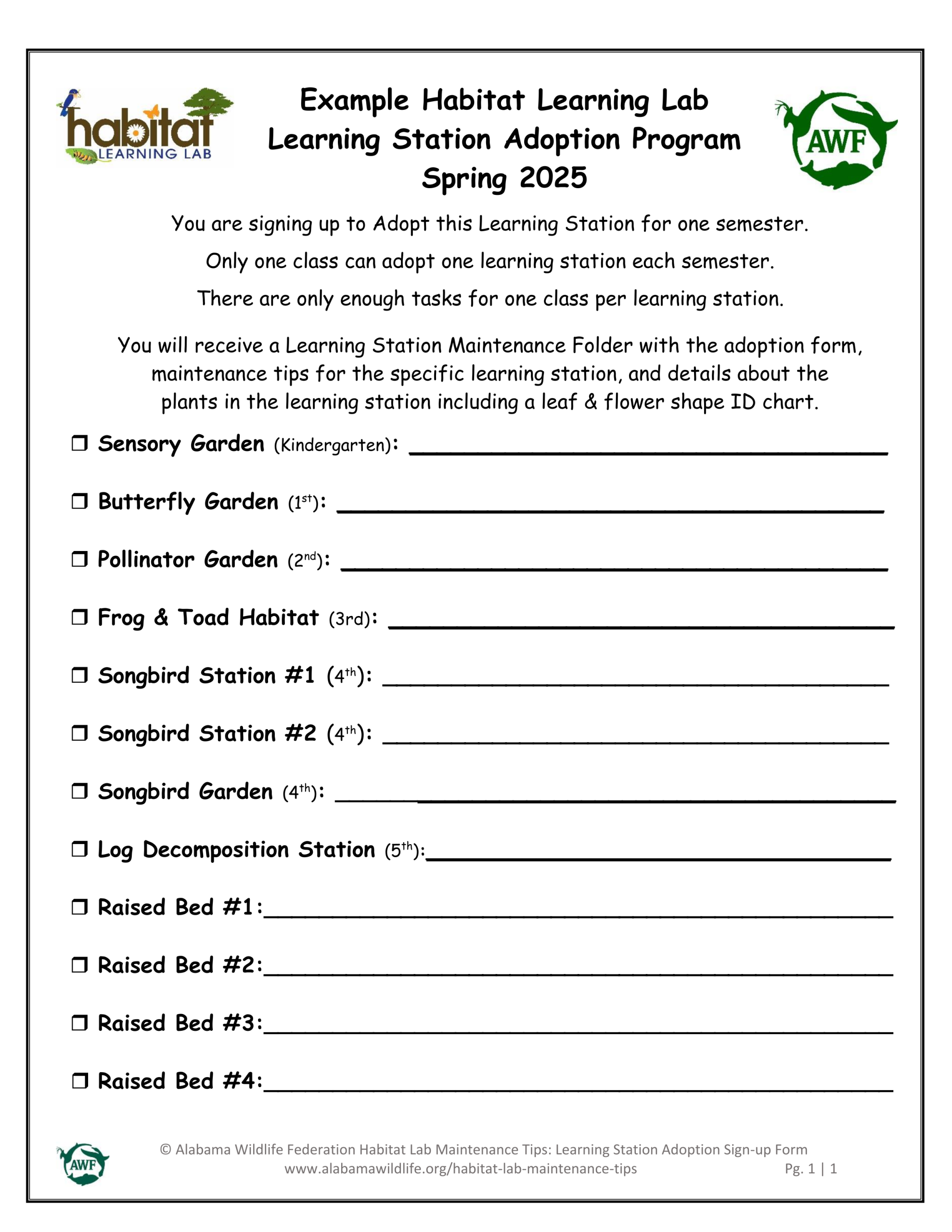
Step 1: Create a list of learning stations that you would like to have teachers and their classes adopt for one semester. Example Learning Station Adoption Sheet: (Word Doc | PDF)
Step 2: Pass around the Sign-up Sheet at the first faculty meeting in August so that teachers (or *club sponsors) can adopt a learning station for the fall semester.
Step 3: Give each class that adopts a learning station the Maintenance Binder (see details below) for the learning station they are adopting. Each binder includes the fall and spring maintenance tips, observation forms, a plant ID map for the learning station, and other helpful resources.
Step 4: Share hands-on activities that the teachers can use in conjunction with the specific learning stations they adopted.
| Learning Station | Grade Level | Habitat Lab Field Investigation Activities | |
|---|---|---|---|
|
Sensory Garden |
Kindergarten |
||
|
Butterfly Garden |
1st Grade |
||
|
Pollinator Garden |
2nd Grade |
||
|
Frog & Toad Habitat |
3rd Grade |
||
|
Songbird Habitat |
4th Grade |
||
|
Log Decomposition |
5th Grade |
||
Step 5: Ask the classes to return their maintenance binders to the Habitat Learning Lab Planning Committee at the end of the semester, so the Maintenance Binders can be redistributed to the teachers who adopt the learning stations the following semester.
OPTIONAL: Scan all of the Observation Forms for all of the learning stations, and then upload them to your HLL Records Hub found at the bottom of your school’s Habitat Learning Lab Webpage (use our Alabama HLL Schools Map to get to your school’s webpage).
Repeat Steps 1-5 for the spring semester
Each Learning Station Maintenance Binder should include the following:
| Learning Station |
Learning Station Adoption/ Observation Form |
Fall Maintenance Tips | Spring Maintenance Tips |
|---|---|---|---|
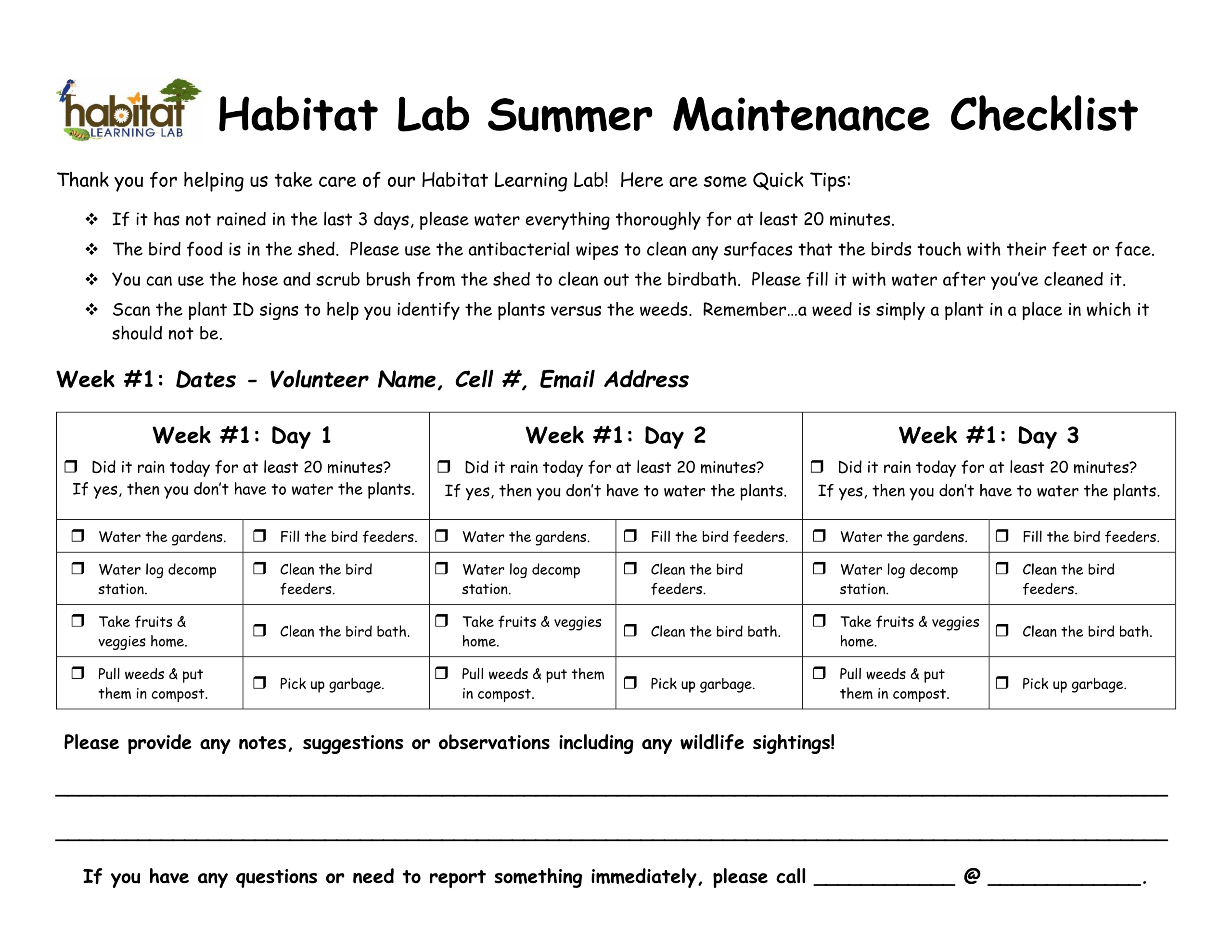
Tip #1: Create a checklist of weekly tasks that need to be taken care of throughout the summer. Example Summer Maintenance Checklist: (Word Doc | PDF)
Tip #2: Recruit students and their parents, student clubs, year-round school staff, community volunteers, or fellow teachers to sign-up for one week to assist with summer tasks.
Quick Tip #1: If you want to know how to care for a specific plant, including how much to water it, visit our Dig Into Plants webpage.
Quick Tip #2: Use the Search feature on the Alabama Cooperative Extension System’s website to find a wide variety of gardening and maintenance tips including:
Quick Tip #3: Download the “How to Protect Your Plants from the Cold” (PDF) to learn more about how cold weather can harm your plants and how to protect them.
Quick Tip #4: Download the “Tips to Control Aphids on Milkweed” to learn how to control these common pests.
Quick Tip #5: Learn how to Reduce Vandalism (even when it’s unintentional vandalism) in your habitat learning lab.
Quick Tip #6: Use our checklists and forms to hold an HLL Work Day to tidy up your HLL, update signage, move plants around, trim bushes, pull weeds, and tend to any other annual maintenance tasks.